


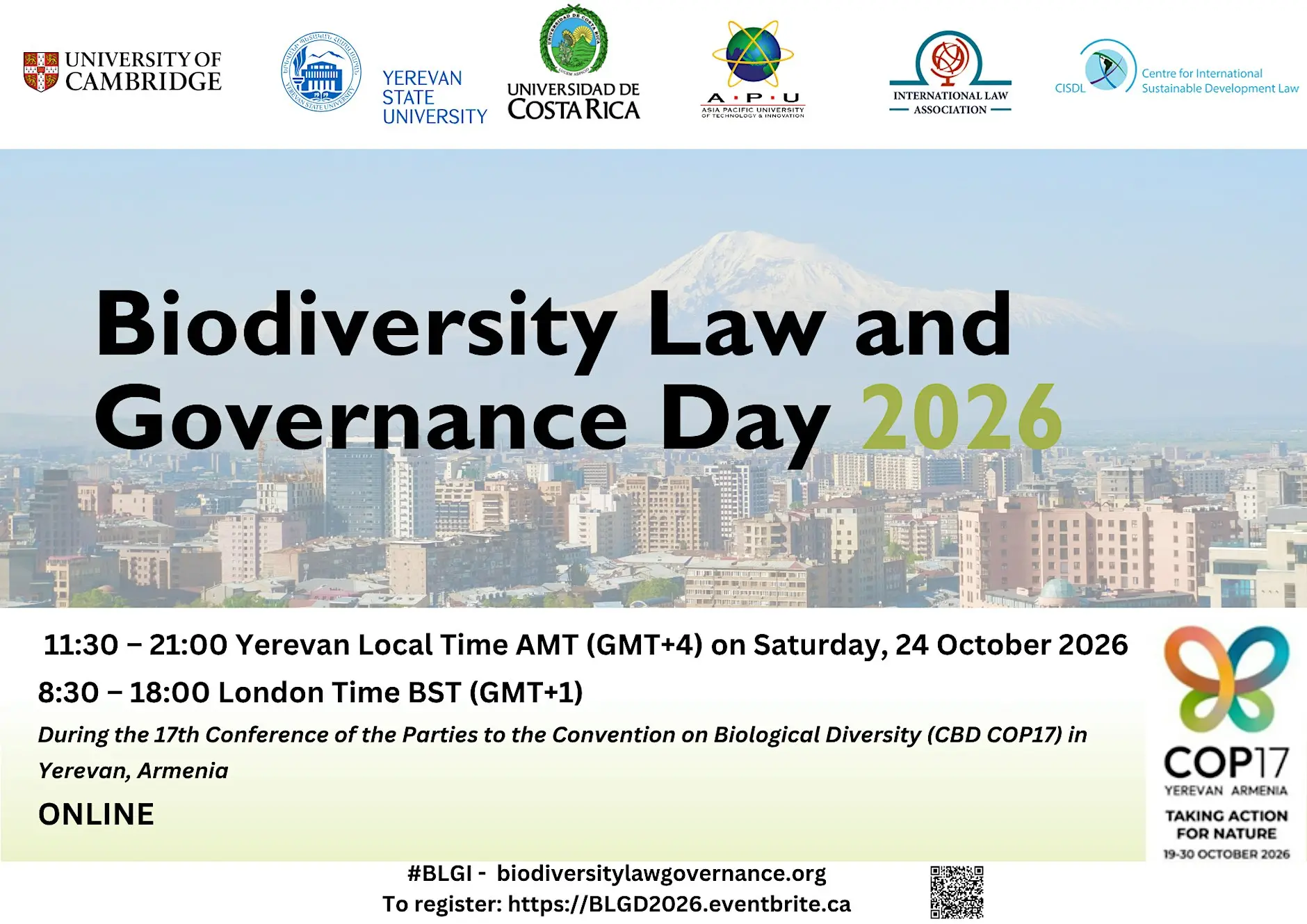
Biodiversity Law and Governance Day 2026
Biodiversity Law and Governance Day 2026
Saturday, 24 October 2026 | 11:30 – 21:00 Yerevan AMT / 8:30 – 18:00 London
ONLINE
During the 17th Conference of the Parties to the Convention on Biological Diversity (CBD COP17) in Yerevan, Armenia
This year’s Biodiversity Law and Governance Day (BLGD 2026) will be held online on Saturday, 24 October 2026, during the 17th Conference of the Parties (COP17) to the Convention on Biological Diversity (CBD) in Yerevan, Armenia.
BLGD 2026 will feature distinguished high-level plenaries, specialist expert panels and legal roundtables, opportunities for international dialogue and collaboration, and the presentation of the 2026 Global Biodiversity Law & Governance Leadership Awards.
Nominations are now open for the three 2026 Global Biodiversity Law & Governance Leadership Awards, recognising outstanding contributions to biodiversity law, policy and governance. Nominations close on 30 September 2026. Submit a nomination here.
Overview
BLGD 2026 aims to advance the implementation of the Kunming-Montreal Global Biodiversity Framework (KMGBF) through law and governance, identifying practical legal, institutional and policy solutions that can support implementation at international, national and local levels.
The symposium will provide a global platform to identify and share innovative legal and governance approaches, implementation experiences, emerging challenges and good practices relating to biodiversity conservation, sustainable use, restoration, benefit-sharing and the prevention of biodiversity loss.
By convening leading legal and public policy experts, government representatives, negotiators, Indigenous Peoples and local community representatives, academics, practitioners, youth, civil society organisations and other stakeholders, BLGD 2026 seeks to catalyse knowledge exchange, strengthen partnerships and generate new biodiversity law and governance insights and solutions.
The symposium further aims to strengthen capacity and collaboration across the global biodiversity law and governance community of practice, supporting implementation of the KMGBF, National Biodiversity Strategies and Action Plans (NBSAPs), CBD COP decisions and related international commitments, while contributing to achievement of the Sustainable Development Goals (SDGs).
BLGD 2026 Themes
BLGD 2026 will focus on four interconnected themes identified to address key legal and governance priorities for the implementation of the KMGBF and the global biodiversity agenda.
1. Implementing the Kunming-Montreal Global Biodiversity Framework through Law and Governance
With implementation of the KMGBF now moving from global commitments toward national and subnational action, effective legal and institutional frameworks are increasingly important. This theme will explore how legislation, regulation, policy, institutions, accountability mechanisms and innovative governance approaches can strengthen implementation of the Framework and associated NBSAPs.
Particular attention will be given to legal reforms, institutional coordination, implementation gaps, Indigenous and customary law, rights-based approaches, diverse values of nature, environmental justice and mechanisms for translating international biodiversity commitments into effective action.
2. Area-Based Conservation, OECMs and Rights-Based Approaches
Achieving Target 3 of the KMGBF requires not only expanding conservation coverage but ensuring that protected areas and other effective area-based conservation measures (OECMs) are effectively governed, equitably managed and capable of delivering long-term biodiversity outcomes.
This theme will examine emerging legal and governance pathways for recognising and implementing OECMs, protected areas and community-led conservation. Discussions will consider Indigenous Peoples and local communities, tenure and land rights, free, prior and informed consent, equitable governance, marine and terrestrial conservation, monitoring and accountability, and links with other international frameworks including the BBNJ Agreement.
3. Access and Benefit-Sharing, Digital Sequence Information and Emerging Technologies
Effective and equitable implementation of access and benefit-sharing (ABS) remains a central element of international biodiversity governance.
This theme will examine implementation of the Nagoya Protocol, traditional knowledge, genetic resources, digital sequence information (DSI) and emerging governance challenges associated with new technologies. It will explore how legal and institutional frameworks can promote fairness, transparency, accountability and meaningful participation while supporting research, innovation and biodiversity conservation.
4. Biodiversity Finance, Capacity-Building and Implementation Partnerships
Implementation of the KMGBF requires significantly greater financial, institutional, technical and human capacity.
This theme will explore the legal and governance dimensions of biodiversity finance, including public and private finance, innovative financial mechanisms, biodiversity and nature markets, accountability and integrity, as well as the partnerships and capacity-building approaches required to translate international commitments into effective implementation.
It will also consider how governments, international organisations, financial institutions, foundations, the private sector, universities, civil society and communities can develop stronger implementation partnerships and mobilise the resources necessary for ambitious and equitable biodiversity action.
More About BLGD 2026
Biodiversity Law and Governance Day 2026 builds on a series of global events convened by partners of the Biodiversity Law and Governance Initiative (BLGI) alongside CBD Conferences of the Parties since COP13 in Cancún, Mexico.
These events mobilise the international law and governance community to support implementation of the Convention on Biological Diversity and, increasingly, the Kunming-Montreal Global Biodiversity Framework.
BLGD provides a space for meaningful dialogue among COP delegates, government representatives, international organisations, legal practitioners, academics, Indigenous Peoples and local communities, civil society organisations, youth, students and other stakeholders interested in the role of law and governance in addressing the global biodiversity crisis.
The 2026 symposium will connect international discussions at COP17 with emerging national, regional and local experiences, enabling participants to exchange practical legal solutions, strengthen professional and institutional networks, and identify opportunities for future cooperation.
About the Biodiversity Law and Governance Initiative (BLGI)
The Biodiversity Law and Governance Initiative (BLGI) is an international partnership bringing together members of the global biodiversity law and governance community, including universities and research institutes, international organisations, legal associations and firms, public institutions, foundations and civil society organisations.
BLGI focuses on legal and institutional responses to the challenges facing biodiversity and seeks to complement and strengthen ongoing international and national efforts.
Its activities centre on three interconnected pillars. First, the BLGI Secretariat convenes and coordinates knowledge-sharing and dialogue alongside CBD processes and beyond. Second, the Initiative supports capacity-building, research, partnerships and biodiversity action among its members and partners. Third, BLGI seeks to involve students, young professionals and emerging leaders from different regions in its activities, strengthening the next generation of biodiversity law and governance expertise.
BLGD 2026 is convened, with the support of the CBD COP17 Presidency and leaders from key international organisations, by an international Programme Committee led by senior experts from Yerevan State University, the University of Cambridge, the University of Costa Rica and Asia Pacific University.


